
Sixteen Arsenal players have been confirmed for the 2026 FIFA World Cup — second only to Manchester City among Premier League clubs — a milestone that reflects the transformation in squad quality under Mikel Arteta. The operational cost arrives in July: Arteta will build his pre-season without a significant portion of his first team, with four of those absences directly committed to the England camp. For a club that just ended a 22-year wait for the Premier League title, the World Cup summer is both a validation of the squad’s quality and a genuine logistical challenge.
Contents
Arsenal’s World Cup Contingent — A Squad Built for This
The 16 confirmed departures span 10 different nations across Europe and South America. Four head to England’s Group L campaign; William Saliba joins France’s squad as one of their starting central defenders; Gabriel Magalhães and Gabriel Martinelli represent Brazil; David Raya, Mikel Merino, and Martín Zubimendi represent Spain; Jurrien Timber is included in the Netherlands squad despite having spent the closing weeks of the season sidelined with injury. Martin Ødegaard captains Norway, Leandro Trossard travels with Belgium, Kai Havertz represents Germany, Viktor Gyökeres leads Sweden’s attack, and Piero Hincapié features for Ecuador. The spread is substantial — Arsenal players will be competing simultaneously across multiple group stages and confederations, meaning injuries, suspensions, and early eliminations will ripple through Arteta’s club planning in real time.
| Player | Country | Group | Group Opponents |
|---|---|---|---|
| Bukayo Saka | England | L | Croatia, Ghana, Panama |
| Declan Rice | England | L | Croatia, Ghana, Panama |
| Eberechi Eze | England | L | Croatia, Ghana, Panama |
| Noni Madueke | England | L | Croatia, Ghana, Panama |
| William Saliba | France | I | Senegal, Iraq, Norway |
| Gabriel Magalhães | Brazil | C | Morocco, Haiti, Scotland |
| Gabriel Martinelli | Brazil | C | Morocco, Haiti, Scotland |
| David Raya | Spain | H | Cape Verde, Saudi Arabia, Uruguay |
| Mikel Merino | Spain | H | Cape Verde, Saudi Arabia, Uruguay |
| Martín Zubimendi | Spain | H | Cape Verde, Saudi Arabia, Uruguay |
| Martin Ødegaard | Norway | I | France, Senegal, Iraq |
| Leandro Trossard | Belgium | G | Egypt, Iran, New Zealand |
| Kai Havertz | Germany | E | Ivory Coast, Ecuador, Curaçao |
| Viktor Gyökeres | Sweden | F | Netherlands, Japan, Tunisia |
| Jurrien Timber | Netherlands | F | Sweden, Japan, Tunisia |
| Piero Hincapié | Ecuador | E | Germany, Ivory Coast, Curaçao |
This level of representation is the cumulative product of Arteta’s squad-building since he took charge in December 2019. When he arrived, Arsenal sat 10th — outside the top six for the first time in a generation, the Emery era having ended in disarray with the club adrift of where their history said they belonged. The 16 World Cup departures are the most visible proof of what has changed since. Signings have been made with international ambition in mind — players who weren’t just Premier League ready but internationally trusted — and the academy pipeline has contributed its share too. The result is a squad where the first eleven, the rotation options, and the depth cover are all competing at the highest international level simultaneously.
For the club, the consequence is direct. The later those 16 players progress in the tournament, the less pre-season preparation time they carry into 2026–27. A player eliminated at the group stage returns to club training by late June or early July. A player who reaches the semi-finals or final remains in competitive football until July 19 — the date of the final in New Jersey — and would arrive back at Arsenal’s training ground with fewer than three weeks before the Premier League opener. For a club defending a first title in 22 years, that margin matters.
England in Group L — Arsenal’s Four in the Frame
England enter Group L alongside Croatia, Ghana, and Panama — a draw that offers a realistic path to the knockout rounds without encountering a top-eight nation before the round of 32. On Cloudbet, England are priced at 7.93 to win the tournament outright — third in the market behind co-favourites France and Spain.
Arsenal’s four England representatives are Bukayo Saka, Declan Rice, Eberechi Eze, and Noni Madueke. Saka and Rice are nailed-on starters for Tuchel — Saka heading into his second World Cup as one of England’s most reliable wide players, Rice providing the midfield security and range that tournament football demands. Eze and Madueke give England a different Arsenal layer: Eze with ball-carrying and invention between the lines, Madueke with direct running from wide areas. Their minutes may depend on how Tuchel balances his attacking options across three group games, but both give England genuine ways to change games from the bench or from the start.
England’s opening fixture against Croatia on June 17 carries specific resonance. Croatia reached the 2018 World Cup final and beat England in extra time in that tournament’s semi-final — a result that still sits in the collective memory. While the Modrić-era core has aged, Zlatko Dalić’s side retain the ability to control games against opponents who underestimate them. Ghana, in transition after sacking their head coach 72 days before their opener, and Panama, returning to World Cup football with limited experience at this level, complete a group that is navigable on paper. How England perform against Croatia specifically will shape how markets and observers read their genuine knockout potential.
The Four Arsenal Players: What They Bring to England
Saka arrives at the World Cup having just completed another outstanding domestic season as part of Arsenal’s title-winning campaign. The 23-year-old heads to North America as one of the most consistent wide forwards in international football, and his second World Cup represents an opportunity to build on a 2022 tournament in which he scored three goals and reached the quarter-finals. Rice has become one of the first names on Tuchel’s teamsheet since making the move to Arsenal from West Ham. His range of passing and ability to break up play make him the engine of England’s midfield, and his Premier League title experience brings a composure to the international setup that wasn’t always present in previous squads.
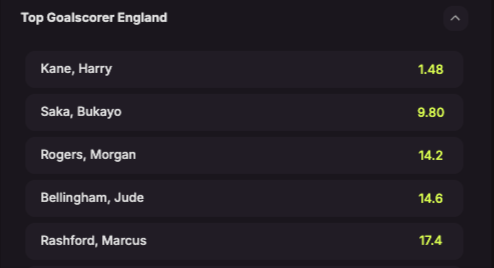
Eze’s inclusion is partly a reflection of how much the playmaker has grown since joining Arsenal. His ability to carry the ball in tight spaces and create from between the lines gives England an option that doesn’t rely on wide overloads alone. Madueke, direct and difficult to contain in one-versus-one situations, gives Tuchel a different wide profile to Saka — useful across a tournament where tactical flexibility becomes as important as quality within individual games.
Pre-Season Fitness Risk — The Return Date Problem
For managers, the World Cup return date problem is one of the most underappreciated variables in early-season performance. Players eliminated at the group stage arrive back with five or six weeks of pre-season ahead of them — enough time to rebuild match sharpness at a reasonable pace. Players advancing to the final arrive with barely enough time to complete a standard pre-season block before competitive football resumes.
The standard response — limiting returning players to partial appearances or substitute roles through the first two to three Premier League rounds — has a direct read-across to early-season player prop markets. A player’s World Cup exit date is often more predictive of August output than their end-of-season club form alone. Arsenal’s opening fixtures of 2026–27 will be shaped as much by when their 16 players come home as by the pre-season schedule Arteta builds around those who didn’t go.
The specific risk for Arsenal is the concentration of absences. Sixteen players covers not just the first eleven but the rotation depth that allows Arteta to manage workloads across a congested fixture calendar. Whether those 16 return carrying accumulated tournament fatigue or exit early and arrive well-rested will define the shape of Arsenal’s start to the defence of their title. Three consecutive runners-up finishes before this season’s title win have left no margin for slow starts — and the World Cup timetable makes a slow start structurally more likely.
Follow Arsenal’s World Cup players through the group stage and into the knockout rounds at Cloudbet, where live betting markets on England and every competing nation update in real time from June 11 to the July 19 final.