
With the 2026 FIFA World Cup opening June 11, the dark horse conversation has moved from speculation to something more concrete — Norway, Colombia, and the United States are the names that keep surfacing as serious contenders. In a tournament expanded to 48 teams across three host nations, what a dark horse can realistically achieve has shifted, and the outright market is pricing these sides accordingly.
Contents
Dark Horse Rankings: What the Analysts Are Saying
Recent ranked lists of the leading dark horse contenders and full 48-team power rankings have landed at similar conclusions: the tier below Spain, France, England, Argentina, Brazil, Germany, and Portugal contains genuine contenders, not token outsiders. The Americas question has narrowed to two sides — can Colombia go all the way (as of April 30th, 40.6 odds to win the World Cup outright), or are the USMNT the strongest of the rest? — while Norway has emerged as the standout European dark horse.
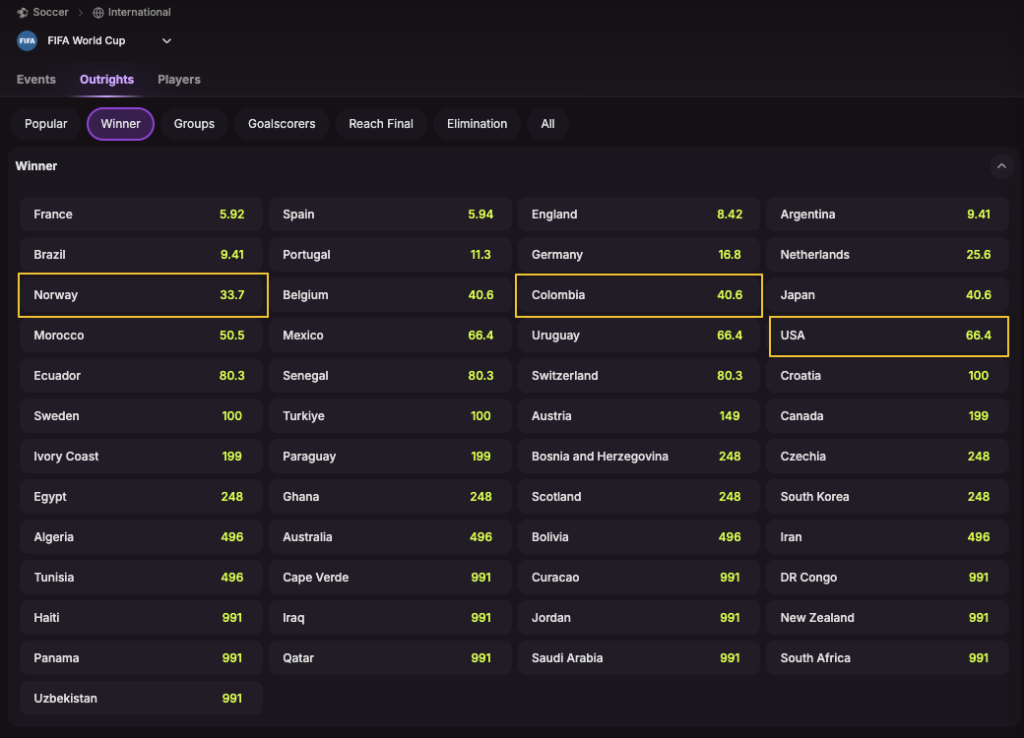
What makes this dark horse field different from past tournaments is the structural opportunity the expanded format creates. With 48 teams across 12 groups of four — the top two from each group plus the eight best third-place teams advance to a Round of 32 — a side can navigate the group stage and avoid the tournament’s best opposition until the quarterfinals. The question for each dark horse candidate is whether their group draw opens that path, and whether they have the individual quality to take it when it does.
Norway in Group I: The Case for Haaland’s Side
Norway’s group draw is the key variable. Group I puts them alongside France, Senegal, and Iraq. France are among the tournament’s outright favourites, which makes topping the group a tall order, but second place is a realistic target — Sports Illustrated itself noted that Norway’s tough Group I means there’s no guarantee they’ll reach the knockout stages, with Senegal and Iraq representing the more winnable fixtures.

The argument for Norway begins with Erling Haaland, whose supporting cast includes Atlético Madrid’s Alexander Sørloth, RB Leipzig winger Antonio Nusa, and midfield heartbeat Martin Ødegaard alongside the steady Sander Berge. The standing question about his international game has been whether elite defensive setups contain him too effectively — but all 16 venues are playing on full-regulation 105×68m pitches — on the wider end of FIFA’s permitted range — creating the kind of space behind defensive lines that suits a striker built to run in behind and score on the counter. The surface context matters.
Colombia, USMNT, and the Americas Tier
Colombia have one of the more favorable draws in the tournament. Group K pairs them with Portugal, Uzbekistan, and DR Congo. Portugal’s squad depth in this cycle makes the second spot competitive from match one. James Rodríguez remains Colombia’s creative focal point, complemented by Bayern Munich’s Luis Díaz and Sporting CP’s Luis Suárez — when that combination clicks, Colombia have the individual quality to produce decisive moments in knockout football. Their 2014 quarterfinal run provides a template: a side capable of building momentum across the group stage and carrying it into the knockout rounds.

The USMNT, coached by Mauricio Pochettino, are in Group D alongside Paraguay, Australia, and Türkiye. Christian Pulisic leads the attack for a team playing on home soil, which historically provides a meaningful edge in knockout football. USMNT might just be the strongest Americas challenger beyond the outright favourites, and even with Türkiye in the mix, their group remains among the more navigable draws for a potential dark horse side.

How the Market and Bettors Are Positioned
Outright tournament pricing on a 48-team field reflects compounding variance. Even a semifinal run requires clearing four knockout matches after the group stage — the probability of any individual team going that far multiplies the uncertainty at each round. Dark horse prices capture that variance accurately; they’re not necessarily mispriced, but they do represent meaningful exposure to high-variance outcomes.
The more instructive picture comes from how bettors engage with World Cup football match by match. On Cloudbet, currently, match odds account for 39% of soccer market activity, making them the dominant bet type by a significant margin. Total goals follow at 27%, Asian handicap at 12%, first-half total goals at 7%, both teams to score at 5%, and team total goals at 4%. The distribution reflects what tournament bettors have always found: individual game results and scoring patterns are more tractable than outright outcomes across seven rounds.
For anyone specifically following the dark horse tier, the relevant question is how match-level pricing adjusts as tournament results shift expectations — a Norway group win, for example, changes how the knockout bracket reads and tends to move outright prices quickly. That dynamic makes group stage performance the most informative signal for anyone positioning on these sides before the knockouts begin.
| Market | Share of Bets | Notes |
|---|---|---|
| Match Odds | 39% | Dominant bet type for group stage |
| Total Goals | 27% | Over/under on full-match scoring volume |
| Asian Handicap | 12% | Goals spread for group stage matches |
| First Half Total Goals | 7% | Scoring tempo in the opening 45 minutes |
| Both Teams to Score | 5% | Whether each side registers at least one goal |
| Team Total Goals | 4% | Individual side’s scoring volume per match |
If you’re tracking the 2026 World Cup outright and group stage markets as the June 11 opener approaches, Cloudbet’s live betting covers the full 48-team field through to the July 19 final. Prices update continuously as team news, group results, and knockout bracket draws shift the picture.