Come funziona l'equità verificabile nel Keno
Ecco come giocare a Keno su Cloudbet e come verificare che ogni estrazione sia equa e verificabile.
Come giocare a Keno
Il Keno è un gioco di estrazione di numeri: scegli una serie di numeri su un tabellone, poi il gioco estrae la propria serie di numeri. Più numeri indovini tra quelli estratti, maggiore sarà la vincita — l'importo della vincita dipende da quanti numeri hai scelto all'inizio. Una volta effettuate le scelte e piazzata la puntata, l'estrazione avviene e i numeri indovinati vengono rivelati all'istante.
Cloudbet Originals Keno
Il Keno Originals di Cloudbet utilizza un tabellone da 40 numeri: puoi scegliere da 1 a 10 numeri e il gioco ne estrae 10. Ha un RTP del 99% e accetta puntate a partire da $0.01. Meno numeri scegli, maggiore sarà la volatilità e più alte le vincite per ogni numero indovinato; più numeri scegli, più frequenti saranno le vincite ma con importi più bassi per ogni numero indovinato. La funzione Auto Bet è disponibile per automatizzare più round.
L'estrazione del Keno viene generata con lo stesso metodo verificabile di ogni altro Cloudbet Original — consulta la nostra panoramica sull'equità verificabile per scoprire come Server Seed, Client Seed e Nonce si combinano per creare una Round Signature e, di conseguenza, una sequenza di numeri casuali tramite SHAKE256. Questa pagina illustra ciò che è specifico del Keno: come quella sequenza di numeri casuali diventa l'effettiva serie di numeri estratti.
Come i numeri casuali diventano un'estrazione del Keno
Il tabellone del Keno è numerato da 1 a 40. Dieci di questi 40 numeri devono essere estratti, uno alla volta, senza ripetizioni.

Chiamiamo P il numero di numeri non ancora estratti rimasti. P parte da 40 e diminuisce di 1 ogni volta che viene estratto un numero.
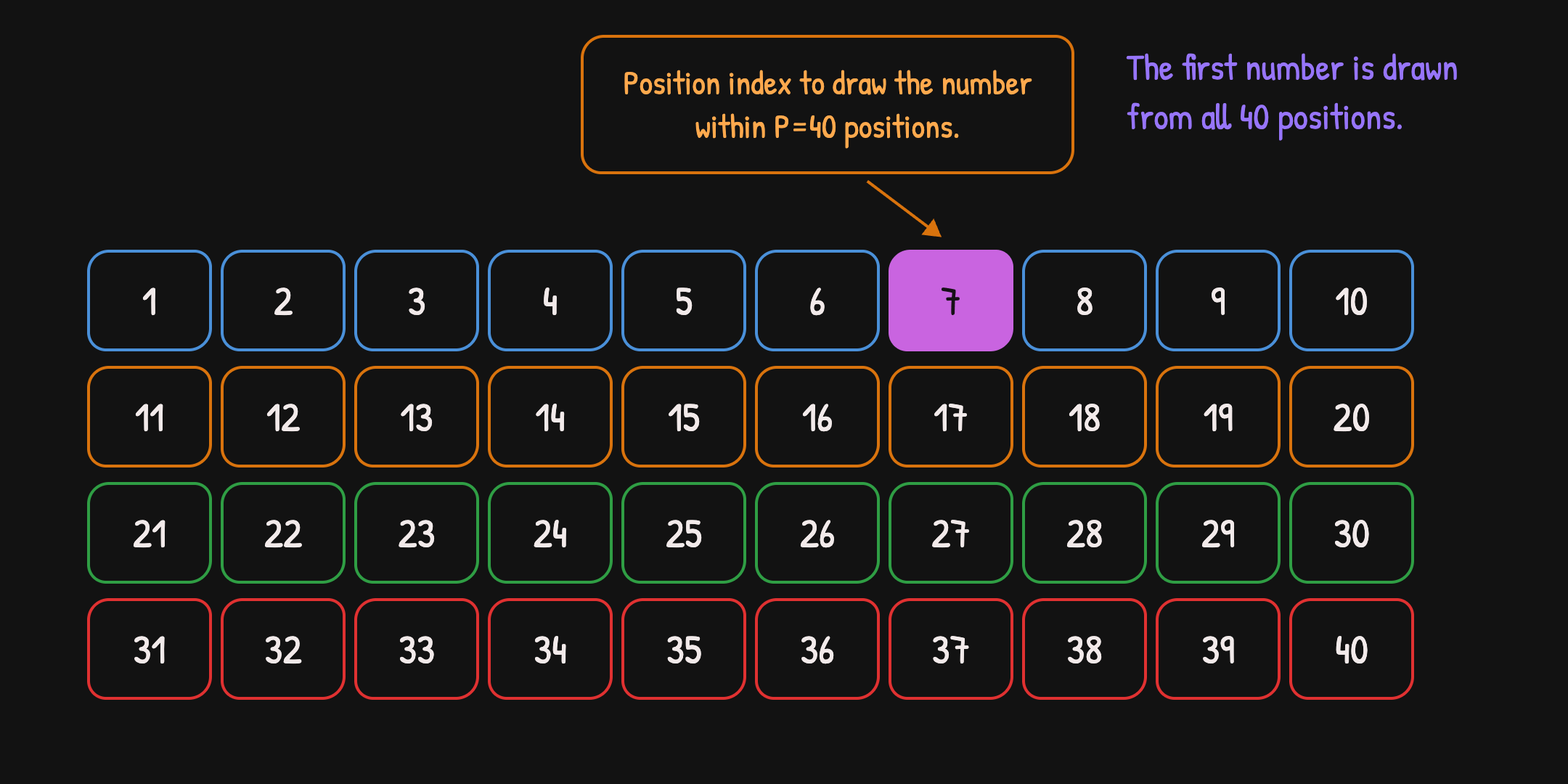
Per ciascuna delle 10 estrazioni viene generato un numero casuale a 4 byte (32 bit) dall'output di SHAKE256, compreso tra 0 e 4.294.967.295. Per scegliere in modo equo tra i P numeri rimanenti, applichiamo il campionamento per rigetto (rejection sampling) (vedi la nostra guida al campionamento per rigetto), poi calcoliamo il resto della divisione del risultato per P per ottenere la posizione del prossimo numero estratto. Se restano altri numeri da estrarre, il numero scelto viene rimosso dal gruppo, P diminuisce di 1 e il processo si ripete.
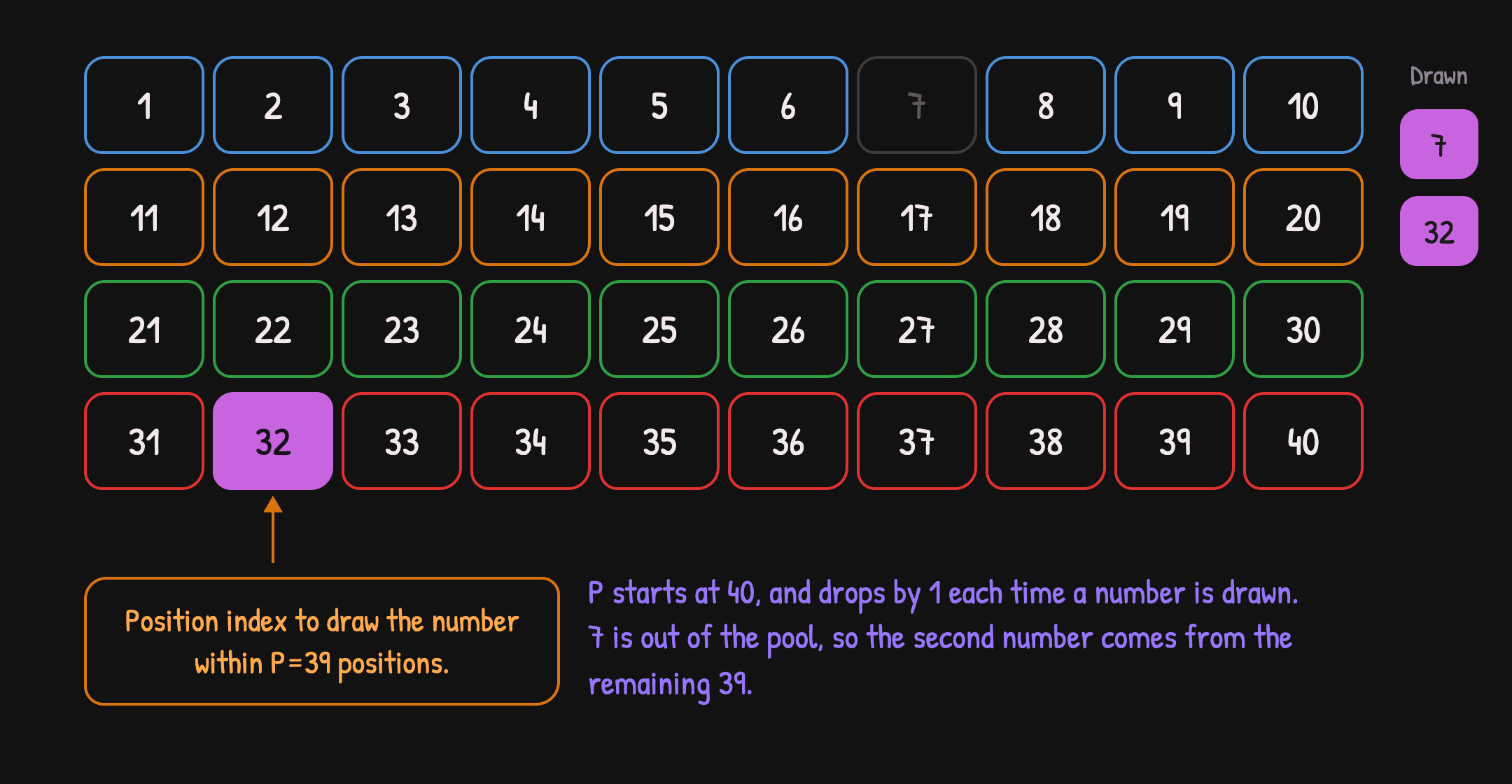
Il processo continua finché non sono stati estratti tutti e 10 i numeri.


Come si gioca
L'intera serie di 10 numeri estratti viene generata e nascosta sul server prima che tu faccia le tue scelte — non può essere modificata o alterata senza essere rilevata in seguito, grazie al Commitment già condiviso con te. Le tue scelte vengono semplicemente confrontate con questa serie pre-estratta al termine del round, e la vincita viene calcolata in base a quanti numeri hai indovinato.
Codice per verificare autonomamente i tuoi risultati di Keno su Cloudbet
Inserisci il tuo Server Seed, Client Seed e Nonce per verificare i tuoi risultati. Installa l'unica dipendenza necessaria ed eseguila tu stesso per ricostruire il risultato della tua partita.
Nota: per rivelare il Server Seed di una partita conclusa su Cloudbet, devi aver già avviato un nuovo round (che genera una nuova coppia di seed).
Dipendenze:
npm install js-sha3
Il codice:
// If you are running this yourself, then you can input your own data here
// You can then compare:
// 1) Cloudbet's provided Commitment to the Commitment outputted here. This proves that the Server Seed was not altered during gameplay.
// 2) Cloudbet's provided mine positions to the mine positions outputted here. This proves that your game's outcome was determined solely by the pre-game seeds and was not altered afterwards.
let myServerSeed      = 'your_server_seed'; // ✍️YOUR_INPUT✍️: Enter your (unhashed) Server Seed here
let myClientSeed      = 'your_client_seed'; // ✍️YOUR_INPUT✍️: Enter your Client Seed here
let myNonce           = 1;                  // ✍️YOUR_INPUT✍️: Enter your Nonce here
const usingCustomData = false;              // Change this to true if you are using your own data

// Load libraries
const crypto = require('crypto');
const { sha3_256, shake256 } = require('js-sha3');

// Step 1: Generate a Server Seed and Commitment
// And generate a Client Seed - either by player input or by the player's browser
function generateServerSeed() {
  let seed = crypto.randomBytes(32).toString('hex');
  if (usingCustomData) { seed = myServerSeed; }
  const commitment = sha3_256(seed);
  return { 'serverSeed': seed, 'commitment': commitment };
}
function getClientSeed() {
  let seed = crypto.randomBytes(32).toString('hex');
  if (usingCustomData) { seed = myClientSeed; }
  return seed;
}

// Step 2: Create a Round Signature with SHA3 using a Server Seed, Client Seed and Nonce
function createRoundSignature(serverSeed, clientSeed, nonce) {
  return sha3_256(`${serverSeed}:${clientSeed}:${nonce}`);
}

// Step 3: Create a SHAKE256 stream generator from a Round Signature.
// To simplify this example program, this function doesn't create a stream, but instead a sequence of custom length.
function* createRandomNumberSequence(numbersToGenerate, roundSignature) {
  const numOfBytes = 4 * numbersToGenerate;           // 4 bytes (32 bits) per random number we generate
  const byteStream = shake256.create(8 * numOfBytes); // shake takes bits as input
  byteStream.update(roundSignature);                  // Use the Round Signature to seed the generator
  const buf = Buffer.from(byteStream.digest());       // The Buffer class lets us package every 4 bytes into one 32-bit integer
  for (let i = 0; i < numbersToGenerate; i++) {
    yield buf.readUInt32BE(i * 4);                    // Read buf in 4-byte steps
  }
}

// Step 4: Pick a number of unique positions
function pickUniquePositions(numOfPicks, totalPositions, rng) {
  const available = Array.from({ length: totalPositions }, (_, i) => i);
  const picks = [];

  for (let i = 0; i < numOfPicks; ++i) {
    const index = sample(available.length, rng);

    picks.push(available[index]);
    available.splice(index, 1); // Remove chosen pump from list of non-faulty pumps
  }
  return picks;
}
// Rejection sampling for fair results
function sample(P, rng) {
  const maxAcceptable = Math.floor(0x100000000 / P) * P;

  // Rejection sampling
  let rand;
  do {
    rand = rng.next().value;
  } while (rand >= maxAcceptable);
  // Modulo operation
  const sampled_number = rand % P;

  return sampled_number;
}

// Example usage
(function main() {
  let nonce = 1;
  if (usingCustomData) { nonce = myNonce; }
  const numOfHits = 10;
  const totalPositions = 40;

  const { serverSeed, commitment } = generateServerSeed();
  const clientSeed = getClientSeed();

  const roundSignature = createRoundSignature(serverSeed, clientSeed, nonce);
  const numbersToGenerate = totalPositions * 2; // We need at least one random number per position, but there is an improbable possibility  we'll need two
  const rng = createRandomNumberSequence(numbersToGenerate, roundSignature);

  let hits = pickUniquePositions(numOfHits, totalPositions, rng);
  hits = hits.map((value)=> value + 1 );
  hits.sort((a, b)=>a-b);

  console.log('📝 Commitment (shown before the game):', commitment);
  console.log('🔒 Server Seed (revealed after the game):', serverSeed);
  console.log('🎲 Client Seed:', clientSeed);
  console.log('🔢 Nonce:', nonce);
  console.log('🔁 Round Signature (can be verified after the game):', roundSignature);
  console.log(`🎯 Hits:`, hits);
})();