
Who is this for?
This module is intended for bettors who encounter World Cup markets such as “Winner,” “To Reach the Final,” or “Group Winner” and want to understand how those markets function across an entire tournament. It is especially relevant for anyone considering bets that remain open for weeks and are influenced by structure, path, and elimination risk rather than a single match outcome.
World Cup outright and futures betting behave differently from match betting. Prices move as tournament pathways evolve, uncertainty resolves unevenly, and public money reshapes the market. This module explains how those forces interact, how to interpret outright odds responsibly, and how to choose the right futures market for the exposure you are taking on.
What you will learn
By the end of this module, you will understand:
- What World Cup outright and futures bets represent in practical terms
- The main outright markets offered during a World Cup and how they differ
- How outright odds reflect probability, uncertainty, and public demand
- What causes meaningful price movement in World Cup futures markets
- How to select outright markets based on structure and variance
Contents
Introduction: Why World Cup outrights exist
Most sports bets settle quickly. Match results, goals, cards, and player props are resolved within a single game. World Cup outrights, often referred to as futures, exist because the tournament itself is a multi-stage event with outcomes that depend on progression rather than isolated performances.
Instead of betting on what happens in one match, outright markets allow bettors to take positions on how the tournament looks at a defined endpoint or stage.
| Market example | What it represents |
| World Cup winner | Tournament champion |
| To reach the final or semifinals | Progress to a specific knockout round |
| Group winner | First-place finish within a group |
| To qualify from group | Advancement from group stage |
| Golden Boot | Tournament top scorer |
These markets are popular because the World Cup has a clear narrative arc. Prices respond to draws, injuries, schedule effects, and projected knockout paths. Understanding those drivers helps bettors interpret World Cup winner odds without overreacting to short-term events.
What is World Cup outright betting?
A futures bet is a wager on a long-term outcome that settles later. In World Cup terms, this usually means betting on the eventual champion or a team’s progress to a specific stage of the tournament.
Outright betting differs from match betting because multiple variables influence the result over time.
| Feature | Impact on pricing |
| Long settlement window | Exposure lasts weeks |
| Cumulative variance | Each round adds elimination risk |
| Structural dependence | Draws and paths matter |
| External factors | Travel, injuries, fatigue |
This structure explains why FIFA World Cup odds can move sharply even when a team has not played. A change in projected opponents or bracket position can alter probability more than a single performance.
Common World Cup futures markets
Use outrights when you want exposure to a team’s overall tournament strength—not a single matchup.
| Market | What you’re betting on | What drives the price |
| Winner (outright champion) | Who lifts the trophy | Overall strength + path + variance |
| To reach semifinals/final | Team makes a specific stage | Bracket path matters more |
| Group winner | Team finishes 1st in its group | Group difficulty + schedule |
| To qualify from group | Team finishes top 2 (or advances) | Less variance than “winner” |
You’ll often see these described as World Cup outright odds, World Cup outright winner odds, or simply futures.
FIFA World Cup 2026 Odds
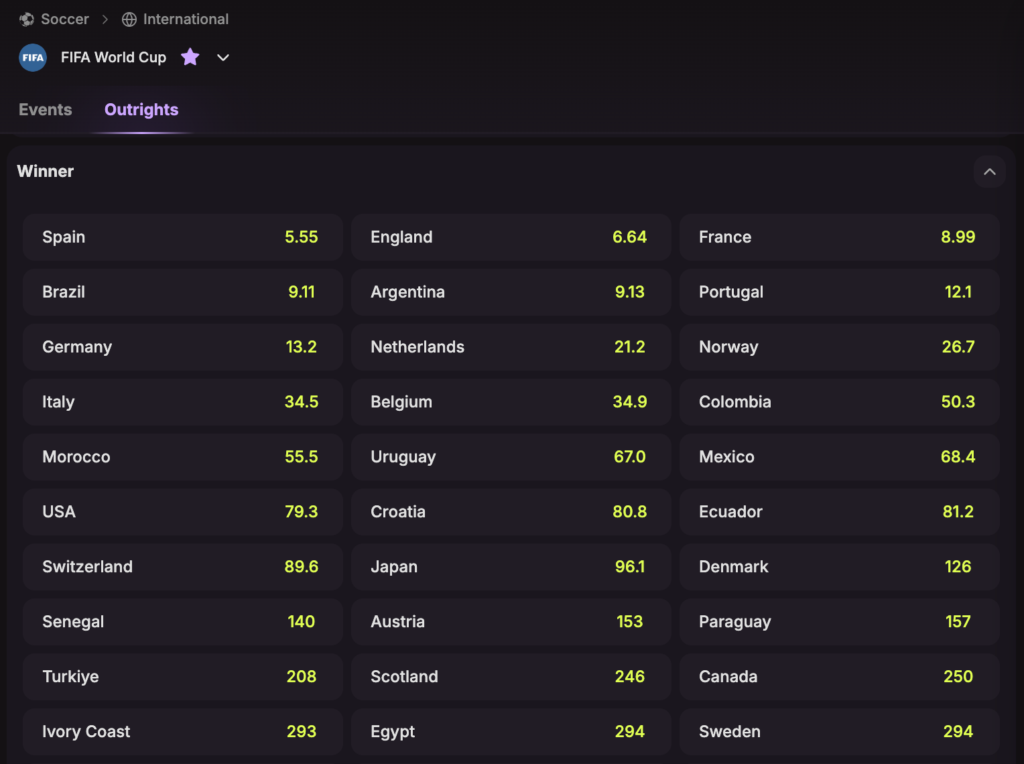
The table above shows the current (January 20, 2026) World Cup 2026 winner betting odds on Cloudbet. These prices reflect how the market is valuing each team’s chances of winning the tournament right now, based on available information.
It’s important to remember that these odds will continue to move as the tournament approaches.
How to read World Cup 2026 odds
The numbers shown are decimal odds. A lower number means that team is considered more likely to win the World Cup, while higher numbers indicate a longer-shot outcome with a larger potential return.
How to think about World Cup outright betting
Favorites are priced to attract money
In most World Cups, the team with the shortest World Cup winner odds attracts the most attention before a ball’s kicked. That doesn’t mean they’re expected to win comfortably. It means the market’s pricing both ability and public confidence.
History shows that even heavily favored teams often fall short once knockout football begins. That’s why outright betting isn’t just about identifying the strongest team. It’s about deciding whether the price on offer makes sense given the format and risks involved.
Early World Cup winner odds look similar
Before kickoff, World Cup outright odds tend to stay close together at the top of the market. That reflects uncertainty rather than indecision.
At that stage, sportsbooks are still accounting for:
- Group-stage outcomes that shape knockout paths
- Remaining playoff qualifiers
- Injuries, squad changes, and form fluctuations
Until teams start playing, those variables can’t be fully resolved. As a result, early prices often compress rather than separate.
What causes World Cup 2026 winner odds to move
As the tournament approaches, World Cup 2026 winner betting odds begin to move more decisively. The biggest shifts usually come from changes to a team’s projected path rather than a single result.
Odds tend to react most strongly to:
- A group result that alters a knockout matchup
- A key injury or suspension
- A team being pushed into a tougher side of the bracket
At that point, outright markets start reflecting structure rather than reputation.
Choosing the right outright market
A World Cup winner bet exposes you to every layer of tournament variance, including the final. In some cases, a stage-based future, such as reaching the semifinals or final, better matches how teams actually progress through the competition.
Both are forms of World Cup betting, but they behave differently once knockout football begins. Understanding that distinction matters more than trying to predict the champion outright.
Myth: the shortest price is the smartest bet
In real markets, the shortest price often reflects public comfort as much as true edge.
Pre-tournament favorites can be correctly priced—and still be poor bets if the number is too short for the volatility involved.
Qatar 2022 is the clean example: Brazil were widely treated as favorites, yet did not win the tournament.
A short price can be “most likely” and still be a negative value if the implied probability is too high for the true risk.
World Cup outright bets involve more uncertainty than match bets
World Cup outright betting is about balancing team quality with price, path, and tournament variance. World Cup winner odds will move as new information arrives, and the biggest edges usually come from understanding why the market shifts—rather than reacting to a single match result or headline.
If you want exposure to a team across the whole tournament, use World Cup outright odds deliberately: translate the price into probability, compare markets (winner vs stage bets), and remember that even the favorite is only a fraction of the total outcome space in a World Cup.
Next modules