Who is this for?
This module is for anyone who wants to place World Cup match bets and understand how common betting markets behave during the tournament.
If you’ve ever looked at a World Cup fixture and wondered whether to bet the result, the draw, goals, or a handicap — and how those choices change between the group stage and knockout rounds — this module gives you the practical foundation most readers expect from a World Cup betting guide.
What you will learn
By the end of this module, you will understand:
- The most common World Cup betting markets available on individual matches
- How World Cup group stage betting differs from knockout betting
- Why match context matters more than reputation alone
- How pressure and incentives shape match-by-match outcomes
- How to approach World Cup bets without overcomplicating decisions
Contents
Introduction: match betting at the World Cup
Match betting is the most familiar form of World Cup betting. Instead of predicting who wins the tournament, you’re betting on what happens in a single game over 90 minutes.
That might include:
- Who wins the match
- Whether the game ends in a draw
- How many goals are scored
- Whether a team covers a handicap
Because the World Cup combines a group stage with single-elimination rounds, the same betting market can behave very differently depending on the stage of the tournament. Understanding that difference is what makes World Cup match betting useful rather than reactive.
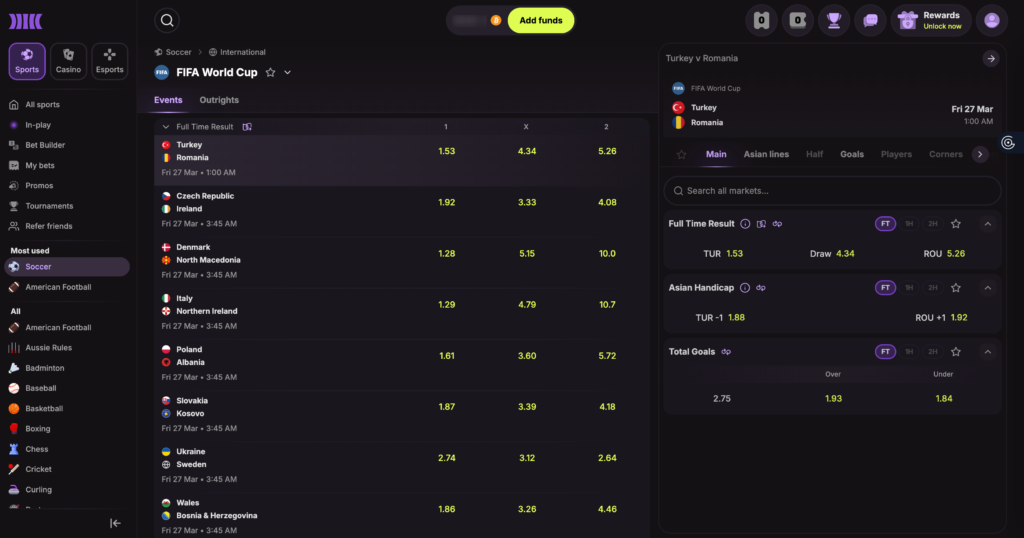
World Cup match betting markets
Most World Cup match betting revolves around a small number of core markets. The difference between them isn’t complexity, but how they respond to tournament context.
| Bet type | What the bet covers | When it’s most relevant | Example bets on real World Cup 2026 fixtures |
| Match result (1X2) | Picks the winner or draw in 90 minutes | Balanced group games and clear mismatches | Spain vs Uruguay – Draw
England vs Panama – England win Argentina vs Jordan – Argentina win |
| Draw betting | Focuses specifically on a level result | Group stage and early knockout rounds | Denmark vs Tunisia – Draw
Switzerland vs Cameroon – Draw Japan vs Costa Rica – Draw |
| Totals (Over/Under) | Predicts total goals scored in 90 minutes | Cautious openers and tense group matches | Morocco vs Croatia – Under 2.5 goals
France vs Senegal – Under 2.5 goals Brazil vs Scotland – Over 2.5 goals |
| Handicap (Asian or spread) | Adjusts for team strength differences | Strong vs weaker teams, mainly in group stage | Portugal -2 vs Uzbekistan
Germany -1 vs Curaçao Belgium -1.5 vs New Zealand |
| Both teams to score (BTTS) | Whether both teams score at least once | Evenly matched or must-win group games | Germany vs Ecuador – BTTS Yes
Argentina vs Austria – BTTS Yes Spain vs Saudi Arabia – BTTS No |
World Cup group stage betting
World Cup group stage betting is shaped by multi-match incentives rather than single-match urgency. With three fixtures available and multiple qualification routes, teams often prioritize control and flexibility over immediate results.
Group-stage behavior tends to follow repeatable patterns that directly affect match markets.
| Group-stage dynamic | How teams behave | Market implication |
| Early match caution | Favorites avoid early defeat | Draws and low totals priced too high |
| Underdog intensity | Lower-ranked teams peak early | Favorites underperform margins |
| Qualification math | Teams manage goal difference | Reduced late-game urgency |
| Group logic shifts | One result changes incentives | Markets lag context changes |
Seeded teams frequently approach their opening match with restraint. Avoiding an early loss protects qualification options and reduces pressure in later fixtures. This often results in slower tempo, limited risk-taking, and an emphasis on game control rather than dominance.
Lower-ranked teams are often most dangerous in their first group match. With no results to protect and full physical freshness, underdogs can commit completely to a defined tactical plan. That clarity tends to diminish as the group progresses and incentives become more complex.
Early surprises can also reshape how an entire group unfolds. A single unexpected result often forces favorites into risk-management mode for the remainder of the group, changing how subsequent matches are played and priced.
Example:
At the 2022 World Cup, Saudi Arabia beat Argentina 2–1 in the group-stage opener. Argentina dominated possession but played at a controlled tempo. Saudi Arabia defended aggressively, held a high line, and committed fully to disrupting the match.
World Cup knockout stage betting
World Cup knockout stage betting at this tournament is different because the knockout phase is larger. With a Round of 32, elimination football starts earlier, and matchups are less uniform.
That creates two very different types of knockout games.
Early knockout rounds: uneven matchups
In the Round of 32, you will see group winners facing third-place qualifiers or lower-ranked teams that advanced conservatively.
In these matches:
- Big teams often play cautiously: Even against weaker opponents, favorites often prioritize control over tempo. An early goal changes everything, so risk is managed carefully.
- Lower-ranked teams aim to survive first: The underdog’s objective is often to stay in the game as long as possible and force mistakes rather than compete openly.
- Games can look one-sided without being high-scoring: Possession and territory don’t always translate into goals.
Essentially, strong favorites don’t always win by large margins, and totals can stay lower than expected despite the quality gap.
Later knockout rounds: fine margins everywhere
As the tournament progresses into the Round of 16 and beyond, matchups become more balanced.
At this stage:
- Quality gaps narrow: Most remaining teams are well organized and comfortable playing under pressure.
- Momentum outweighs reputation: Teams that arrive with confidence and structure can neutralize higher-ranked opponents.
- Patience becomes a weapon: Many teams are content to let matches drift, knowing that one moment can decide everything.
Example:
At the 2022 World Cup, Croatia vs Brazil stayed level through 90 minutes despite Brazil’s attacking talent. Croatia managed the game, limited space, and pushed the match to penalties — where they advanced.
Why knockout markets behave differently
Because of this structure:
- Draws at 90 minutes become more relevant
- Handicap lines tighten quickly
- Totals often reflect caution rather than intent
In World Cup knockout stage betting, the question isn’t who is better, but who is willing to wait longer without making a mistake.
Understanding how the expanded knockout phase creates both mismatches and tight contests is essential when betting individual World Cup matches.
How to bet on World Cup matches responsibly
Responsible World Cup match betting is less about predicting the better team and more about anticipating how each side is likely to manage risk within the match. Tournament football rewards caution, particularly when elimination or qualification is at stake.
Several practical principles consistently apply across World Cup matches.
| Practical tip | What it means in practice |
| Draws remain live outcomes | Many teams, especially underdogs, are content with a draw and may protect that result rather than chase a win |
| Underdogs often play for survival | Lesser teams frequently prioritize staying level and extending the match, sometimes with the intention of reaching penalties in knockout games |
| Favorites manage risk carefully | Stronger teams often avoid early overcommitment to prevent conceding first and complicating the match |
| Tempo is controlled, not constant | Matches may remain slow for long periods before urgency appears late |
| Game state matters more than possession | Control and territory do not always translate into attacking intent |
In group-stage matches, teams may accept draws if it keeps qualification scenarios intact. In knockout rounds, underdogs often focus on delaying the match and forcing mistakes, while favorites are reluctant to take risks that could expose them to elimination.
Because of this, betting decisions should account for patience and caution as much as perceived quality. Markets such as draws, tighter handicaps, and lower goal totals often reflect how teams actually approach World Cup matches rather than how they appear on paper.
Match context, incentives, and risk tolerance consistently matter more than rankings or reputation when betting on individual World Cup games.
Myth: Every World Cup match is played to win
It’s easy to assume every World Cup match is played at full intensity from kickoff. In reality, many matches, especially in the group stage, are played to avoid losing.
Teams regularly manage risk, accept draws, or conserve energy for later games. Betting markets reflect this reality, which is why understanding incentives is essential when placing World Cup match bets.
Conclusion: World Cup match betting is a different game
World Cup match betting is about context, not just teams. The same markets behave differently depending on whether a game is part of the group stage or a knockout round.
By understanding how incentives, pressure, and tournament structure shape individual matches, you can approach World Cup betting markets with clearer expectations and fewer assumptions.
This module gives you the match-by-match foundation. From here, you’re ready to explore more specific markets as the tournament unfolds.