Who is this for?
It’s particularly useful for bettors who want to move beyond simple match winner bets and start understanding how map selection, side balance, and team strengths influence outcomes. At this stage, you begin looking at how a team performs on specific maps rather than treating every match as equal.
What you will learn
By the end of this module, you will understand:
- How to read team map statistics and identify real strengths and weaknesses
- Why some maps favor the CT side while others lean toward the T side
- How economy rounds influence total rounds betting markets
- How perma-bans and map pools shape betting opportunities
- When map-specific handicaps offer more value than match winner bets
Contents
- 1 Introduction: why maps change everything
- 2 Understanding team map pools
- 3 Reading team map statistics effectively
- 4 Understanding T-side vs CT-side map tendencies
- 5 How economy rounds affect total rounds betting
- 6 Map-specific handicap strategies
- 7 Myth: every map plays the same
- 8 Map knowledge creates smarter betting decisions
Introduction: why maps change everything
In CS2, not all maps play the same. Each one has its own pace, layout, angles, and strategic tendencies. This means a team that looks dominant overall may struggle badly on a specific battleground, while another team might become far more competitive once the match moves onto a map they prefer.
This is why map betting is often where more advanced bettors focus their attention.
Instead of asking, “Who is the better team?”, the question becomes:
- Which team is stronger on this map?
- Does this map suit their playstyle?
- Is the expected scoreline likely to be close or one-sided?
Once you start thinking in terms of individual maps, markets like total rounds and map handicaps begin to make much more sense.
Understanding team map pools
Every professional CS2 team has a map pool profile. This simply means the set of maps they are comfortable playing — and the ones they avoid.
Most teams fall into a familiar pattern:
| Map pool trait | What it means |
| Perma-ban | A map the team almost always removes first |
| Comfort pick | A map the team regularly chooses |
| Stable maps | Maps they can play confidently |
| Weak maps | Maps they struggle on |
These preferences aren’t just theory. Some of the most successful teams in Counter-Strike history built clear identities around specific maps.
During their dominant era in 2018–2019, Astralis became almost unbeatable on Nuke, putting together a famous 26-map LAN winning streak on the battleground. Opponents often banned Nuke immediately just to avoid playing them there. That level of map dominance effectively gave Astralis a built-in advantage in many series before the match even started.
At the other end of the scale, teams often develop true perma-bans. When Anubis was introduced to the active map pool, many top teams initially removed it in nearly every series because they were uncomfortable playing it at the highest level.
This matters for betting because it helps explain why some matchups look very different once the veto is complete. A team might look strong overall but becomes far more vulnerable if forced onto a map they avoid.
Reading team map statistics effectively
Looking at map stats is one of the most useful ways to understand a team’s real strengths.
Instead of only checking match results, bettors often look at:
- Win rate on each map
- How often a team picks a map
- How often they ban a map
- Round differential (how dominant wins and losses are)
These numbers help build a clearer picture.
| Stat type | What it tells you |
| High win rate on a map | Strong comfort pick |
| Frequent bans | Likely a weak map |
| Close round differentials | Competitive but inconsistent |
| Large round wins | Potential for handicap value |
For example, teams like G2 have historically posted strong win rates on maps such as Inferno during certain roster periods, making it a frequent pick and a reliable battleground for them. Over time, patterns like this become visible in the data and help explain why some maps appear in a series more often than others.
A team with a 70% win rate on one map but a 35% win rate on another is not the same team across both environments. Treating them as equally strong everywhere can lead to misreading odds.
Understanding T-side vs CT-side map tendencies
What CT and T mean
In CS2, each map is played between two sides:
- T (Terrorists) are the attacking side. Their goal is to take control of bomb sites, plant the bomb, and defend it.
- CT (Counter-Terrorists) are the defending side. Their job is to stop the plant or defuse the bomb if it’s placed.
Teams switch sides halfway through the map, so both teams play attack and defense. Even so, the design of each map can make one side slightly easier to play than the other.
Why side balance matters for betting
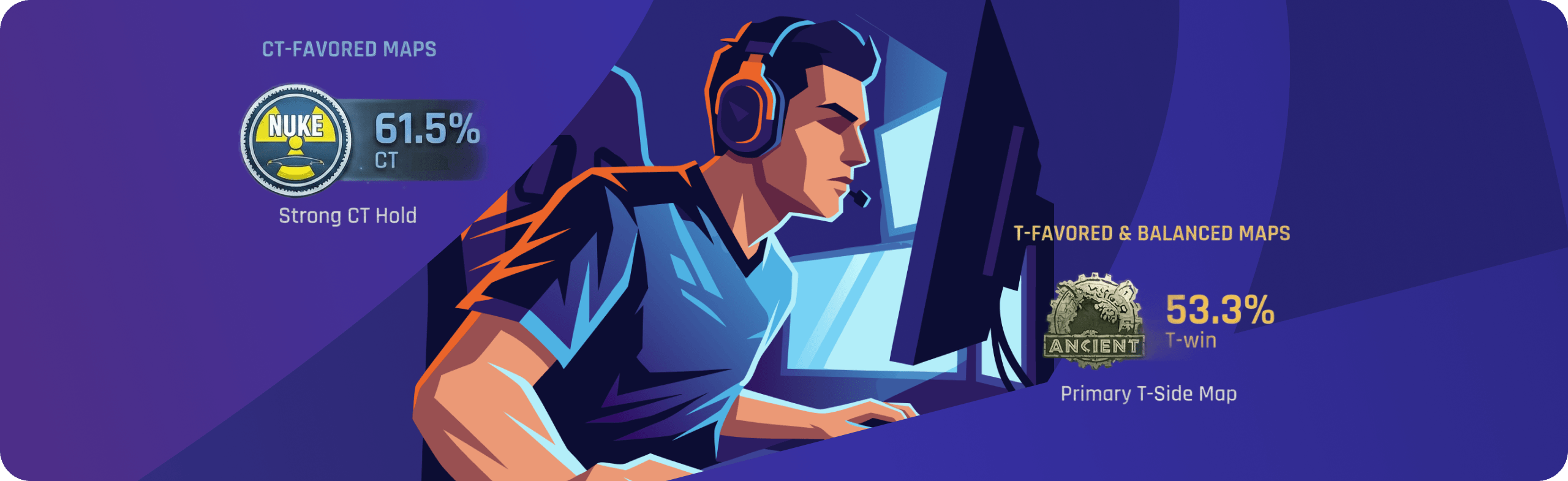
Not every map is evenly balanced. Some layouts naturally favor defenders, while others give attackers more room to create openings.
This is known as the map “meta,” and it shifts over time as strategies develop and updates change the game. Because of this, it’s important to research how each map is currently playing rather than assuming they’re all the same.
| Map balance type | What it means | Betting impact |
| CT-favored maps | Defenders tend to win more rounds | Leads can be harder to break, lower total rounds possible |
| T-favored maps | Attackers find it easier to take space | Momentum swings more likely |
| Balanced maps | Similar win rates for both sides | Closer matches, higher round totals |
Side balance has a direct impact on total rounds markets.
On heavily defensive maps, a strong CT half can create:
- Large early leads
- One-sided scorelines
- Lower total round counts
On more balanced maps, matches are more likely to stay competitive across both halves, which often pushes total rounds higher.
The key takeaway is that maps are not neutral. Understanding which side a map currently favors helps you better judge whether a game is likely to be close, dominant, or swing back and forth.
How economy rounds affect total rounds betting
In CS2, teams earn money after every round. They use that money to buy weapons, armor, and grenades at the start of the next round.
This system is known as the in-game economy, and it has a big impact on how competitive each round is.
What is an eco round?
If a team loses several rounds in a row, they don’t have enough money to buy strong equipment. When that happens, they often choose to save their money for the next round instead of spending it.
This is called an eco round.
During an eco round, a team might use:
- Basic pistols
- Little or no armor
- Very limited utility
They’re much less likely to win these rounds because the other team usually has better weapons.
How economy affects match flow
Because of the money system, rounds often come in streaks.
If one team keeps winning rounds:
- They earn more money
- They can keep buying strong equipment
- The losing team is forced into weaker eco rounds
This can create a snowball effect where one team builds a large lead quickly.
| Economy situation | What it usually means | Impact on the match |
| Both teams have full money (full buy vs full buy) | Even fight | More competitive rounds |
| One team saving (eco round) | One team has weaker weapons | Higher chance of quick round wins |
| Repeated losses | Team runs out of money | One side can build momentum |
Why this matters for total rounds betting
Total rounds betting is about predicting how many rounds will be played before one team reaches 13 wins — in other words, how long a map will last.
For example:
- A one-sided map might finish 13–7 (only 20 total rounds).
- A close, back-and-forth battle could go all the way to 13–11 (24 total rounds).
Bettors use common lines such as “Over/Under 22.5 rounds” to decide whether they expect a quick blowout (Under) or a longer, competitive contest (Over).
The economy plays a big role in this.
- If one team controls the economy, they can win several rounds in a row and build a big lead. This often leads to shorter, one-sided maps.
- If both teams keep trading rounds, both sides stay financially strong. That usually leads to closer matches and more total rounds played.
So when a match becomes very one-sided early, it often stays that way because the losing team struggles to afford good equipment. When the game stays competitive, both teams keep buying strong weapons, and the scoreline stays close for longer.
Understanding this helps explain why some maps end quickly, while others go deep into the round count.
Map-specific handicap strategies
Map handicaps are one of the most common ways to find value once you understand map pools and tendencies.
Instead of betting only on who wins the map, you can bet on the margin of victory.
| Handicap approach | When it makes sense |
| Backing a strong favorite | When they’re on a comfort map |
| Backing the underdog +rounds | When the map favors close games |
| Avoiding handicaps | When teams have similar map strength |
For example, if a team is known to dominate a particular map and the opponent struggles on it, the chance of a clear scoreline increases. In those situations, a map handicap can offer better value than simply betting on the winner.
On the other hand, if both teams are strong on the map, the game is more likely to be competitive. That can make total rounds markets more appealing instead.
Myth: every map plays the same
All CS2 maps look similar at a glance, but they don’t play the same.
Some maps slow the game down and favor defensive setups. Others reward fast, aggressive attacking play. Because of this, the same two teams can look completely different depending on which map they’re playing.
That’s why map-specific analysis often reveals opportunities that match-level analysis misses.
Map knowledge creates smarter betting decisions
Once you move past match winner bets and start thinking map by map, CS2 betting becomes far more detailed.
- Team map pools reveal strengths and weaknesses.
- Side balance influences how matches unfold.
- Economy swings shape round totals.
- Handicaps become more meaningful when tied to specific maps.
Understanding how maps affect performance helps you interpret odds more clearly and identify where results are likely to be close, one-sided, or high-scoring.